
Our Funded Research Projects
In January 2026 we funded five innovative research project, three feasibility studies and two Knowledge Exchange Placements. See full press release here.
If you’d like to engage with any of the teams, please reach out to them directly or contact us for an introduction.
Read more about our feasibility studies below.
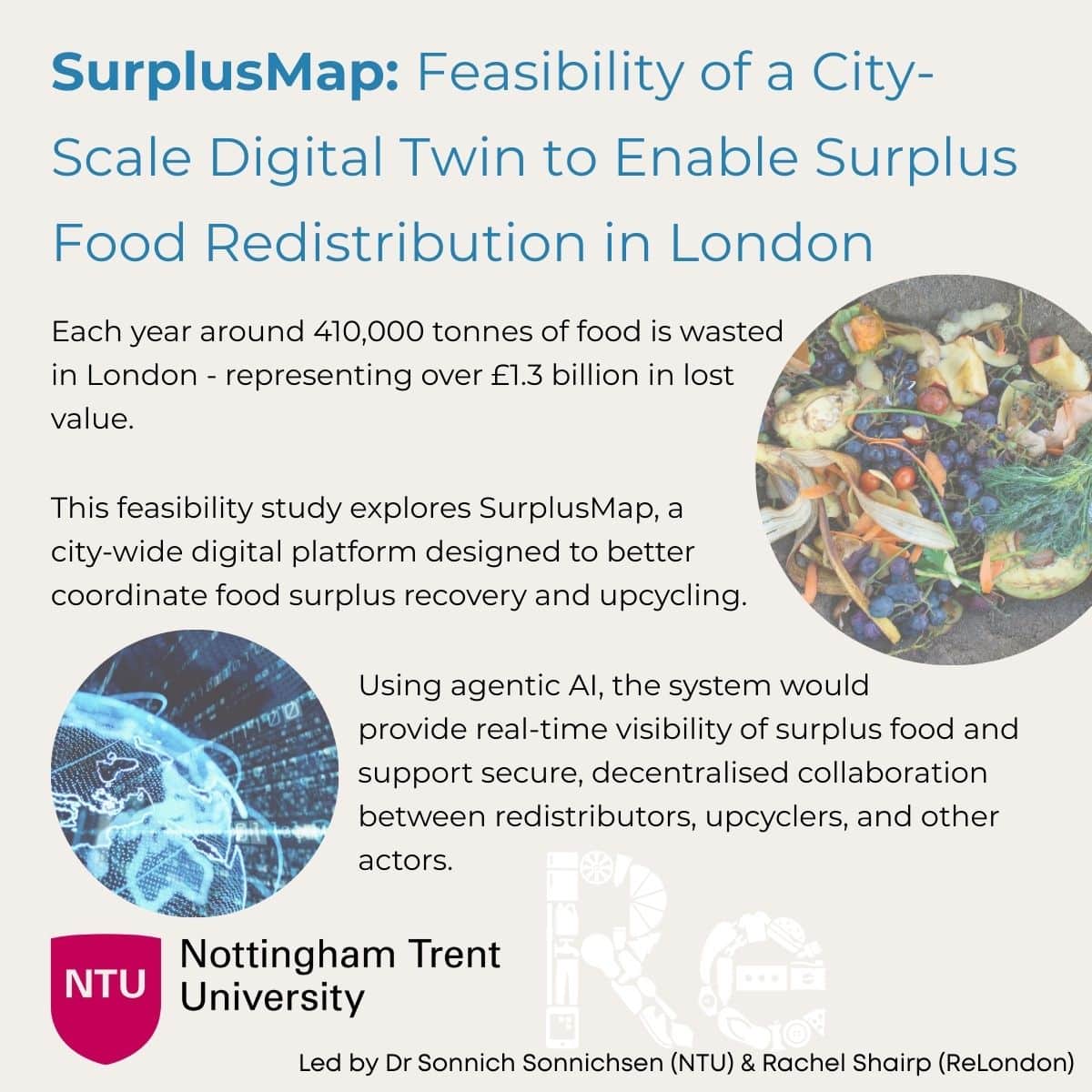
SurplusMap
Led by Dr Sonnich Sonnichsen from Nottingham Trent University and Rachel Shairp of ReLondon.
The study will assess technical options, data governance, and participation incentives.
Its goal is to prepare for a scalable pilot that transforms food surplus into value, reduces system inefficiencies, and supports a more circular economy in London.
The Nottingham Trent University has partnered with ReLondon.

Busloads of Value
Led by Dr Jay Lin and Dimitrios Pappas from Queen’s University Belfast.
Two Core Contributions:
Minimal Viable Battery Passport
Operator-ready, proportionate, contract-linked:
- Only fields that change decisions
- Attribute → clause → governance rule
TL-BMC as Contract Design Tool
Two contractable archetypes:
- Resource Security (rights, take-back, verified routing)
- Circular Local Value (second-life storage, shared value)
Project Structure
WP1: Synthesis and passport co-design
WP2: Archetypes and viability conditions
WP3: Contract-ready blueprint and clause library

Robotic and AI-Enabled Sensing for Timber Reuse
Led by Dr Vijay Pawar & Dr Colin Rose from UCL.
The team address a gap in open-access datasets to stimulate SME engagement and widen research collaboration.
In the future, combining Robotics, AI and circular design principles will create a digital infrastructure enabling new approaches to value generation that transform waste into trusted, low-carbon materials