

Our Funded Research Projects
Through our £450,000 Flexible Fund programme, DICE Network+ has supported 18 research and knowledge exchange projects, bringing together researchers and industry partners to explore how digital innovation can accelerate the transition to a circular economy.
Our funded portfolio includes 10 Knowledge Exchange Placements, 6 Feasibility Studies and 2 Demonstrator Projects, spanning sectors from fashion and construction to food systems, telecommunications and space infrastructure.
Discover the projects and the innovative approaches they are developing below.
Knowledge Exchange Placements
10 funded projects
Our Knowledge Exchange Placements bring together researchers, industry partners and organisations across disciplines and sectors to share expertise, strengthen collaboration and explore new opportunities for digitally enabled circular innovation.

From Practice to Publication: A Knowledge Exchange Placement to Develop a Peer-Reviewed Academic Case Study on Digitally Enabled Circular Fashion at Advanced Clothing Solutions (ACS)
University of Exeter | Led by Vin Sharma
ACS, Europe’s largest circular fashion hub, is the subject of a published DICE Network+ case study (Bermudez and Sharma, 2026). This placement embeds the PI at ACS to gather additional empirical material, supplementary interviews, operational data, and practitioner validation, needed to develop that case study into a peer-reviewed journal article. The paper will theorise how digital infrastructure enables and constrains circular business model transitions, contributing to management and organisational behaviour literatures. Findings will be presented in developmental form at BAM 2026 (London) before a refined paper is submitted to EGOS 2027 (Liverpool) and developed for journal submission by December 2027.

CIRCUIT: Circular and Resilient Net-Zero Cities through Inclusive Urban Intelligence and Stakeholder-in-the-Loop Digital Twins
University of Birmingham | Led by Weiqi Hua
This placement will establish a UK-Japan knowledge exchange between the University of Birmingham (UoB) and Keio University (KU) on digital twins, urban planning, and circular economy approaches for resilient net-zero cities. Using Birmingham and Yokohama as comparative case studies, the placement will assess data-sharing feasibility, model compatibility, and the transferability of indicators for carbon, cost, circularity, and resilience. It will combine UoB’ s experience on multi-energy system digital twins, life-cycle assessment, with KU’s expertise on urban design and stakeholder-informed planning. This placement will provide a practical foundation for future research, policy consultancy, and stakeholder-informed pathways towards urban digitalisation and circularity.

Waste Valorisation Pathways for Circular Agri-Food Supply Chains in the UK
University of Surrey | Led by Amin Zarei
This Knowledge Exchange Placement builds on an ongoing UK agri-food supply chain study (VF-UKFSR) spanning vertical farming, greenhouse, and conventional field production systems. The placement will introduce and integrate a structured waste management and circular economy component across these systems, defining and analysing pathways for organic, general, and recyclable waste, including anaerobic digestion, composting, energy-from-waste, landfill, and recycling. Engagement with an industry partner will ensure that assumptions and routing scenarios reflect operational realities. The work will enhance analytical depth, strengthen practical relevance, and support dissemination through workshops and conferences, reinforcing the circular economy dimension of the research.

Predicting item desirability with machine learning to boost digital platform exchanges
Newcastle University | Led by Clement Lee
When household items are advertised on the digital gifting platform Freegle, knowing how desirable they are to different user groups at the time of advertising would enable strategic promotion to the most relevant users, improving the likelihood of an item being repurposed. Recent advances in machine learning enables this task using the text description and the images of the items. The predicted desirability can be validated against the number of users expressing interest within a certain amount of time. This project is expected to optimise the group of targeted users, increase the likelihood of success, and improve user satisfaction.

Unlocking the value of DPPs for the UK fashion sector ahead of compliance
University of Manchester | Led by Dr Courtney Chrimes
This placement will establish a KE partnership between the University of Manchester and WRAP to accelerate the UK fashion sector’s preparedness for Digital Product Passports (DPPs). Despite EU DPP compliance being pushed back to 2030, stakeholders across the value-chain must build capability now. To date, most DPP research and legislation has focused on upstream supply‑chain actors, yet downstream stakeholders – reuse services and disposal pathways – are essential for circularity. Through a series of KE sessions and a multi-stakeholder event, this project will map DPP readiness, gaps and opportunities, producing a Stakeholder Landscape & Readiness Report with actionable recommendations.

Bridging local wisdom & scientific Innovation: a citizen science approach to climate resilience in the Mekong Delta (Vietnam)
University of Exeter | Led by Bach Nguyen
This placement strengthens circular‑economy research links between the University of Exeter and Vietnam’s Environment for Development Centre. It will co-design a citizen-science platform that enables Mekong Delta farmers to integrate local knowledge into scientific models, yielding tailored climate-adaptation advice that improves productivity, sustainability, and resilience. During the visit, the PI and Vietnamese colleagues will refine research questions, methods and funding strategy, and conduct exploratory interviews and ethnographic observations with 20 farmers to ensure the platform’s usability and relevance. Outcomes include a pilot dataset, a publication plan, and a strengthened international partnership, advancing the literature on citizen science, circular economy, and tech-enabled climate adaptation in agri-entrepreneurship.
Knowledge exchange for digital product passports: from electric batteries to endoscopes
University of Sheffield | Led by Divya Tiwari
The Digital Product Passport (DPP) represents a significant advance in product transparency, traceability and sustainability. With current EU regulations on DPP implementation, the UK is considering adopting a similar system. However, there is limited evidence to quantify the benefits of DPPs in the medical technology (MedTech) sector, where the supply chain involves multiple stakeholders without a unified system to track materials, maintenance or repair history, thus creating a barrier to circularity. This barrier could be reduced by using DPPs. This placement aims at cross-sector learning and interdisciplinary collaboration by transferring knowledge from a well-developed DPP project for electric batteries in the automotive sector to inform DPP requirements for the MedTech sector.

Sustainable Semiconductor Device Innovation for Space-Based Solar Power: Knowledge Exchange Between Research and Industry
University of Liverpool | Led by Jiafeng Zhou
This placement investigates sustainable semiconductor device technologies for future Space-Based Solar Power (SBSP) systems through coordinated academic–industrial knowledge exchange. Two visits to the Centre for Integrative Semiconductor Materials (CISM) group, Swansea University, will examine material platforms, device architectures, and fabrication routes that enable high efficiency, long lifetime, and radiation-tolerant operation. Another visit to an industrial manufacturer United Monolithic Semiconductors (UMS) in France will map SBSP performance requirements onto existing capabilities and identify opportunities for collaboration. Together, these activities will reveal research gaps, highlight circular-economy considerations in semiconductor design, and generate a technical roadmap to guide future proposals, feasibility studies, and cross-sector partnerships relevant to the DICE Network+ mission.
The business case for battery traceability: exploring Digital product passports (DPPs) and circular value creation
Kings College London | Led by Emma Fromberg
The transition to a circular economy requires businesses to operationalise and create value in new ways along entire product life cycles. Batteries are central to electrification and decarbonisation, demanding stewardship across all stages to maximise value and recover materials. This project explores the business case for battery traceability through digital product passports, developed with Circularise, a company offering DPP solutions. It investigates how traceability can create strategic and financial value beyond compliance, enabling second-life applications and new circular business models. The study also addresses resource resilience, economic viability, and policy design for critical materials and digitally enabled circular supply chains.

Future Histories: Weaving Data into Digital Storytelling for Circularity
University of Exeter | Led by Hollie Kirk
The UK economy continues to face challenges from unsustainable patterns of production and consumption, with limited tools available to help consumers understand and reduce their environmental impact. This placement will explore how digital storytelling and product data can help consumers value and extend the life of everyday items. By working with industry partners, we will test new ways to share product histories and create mock-ups of a digital platform concept. The outcomes will provide insights for businesses and consumers, while contributing practical knowledge and innovation to support the transition to a circular economy.
Feasibility Studies
6 funded projects
Our Feasibility Studies investigate the technical, economic and practical potential of innovative approaches to digitally enabled circularity, helping to identify opportunities, address barriers and build the foundations for future research and real-world application.
Digital Material Intelligence for Circular Space Infrastructure: A Feasibility Study
University of Surrey | Led by Jin Xuan
This feasibility study will explore whether digital material intelligence can support a circular economy for space infrastructures. As a short-term feasibility study, we will design and populate a minimal, high-quality database that links satellite components, fabrication materials and orbital environments. Using a small number of representative test cases, we will trial Machine Learning-based predictive methods to estimate material condition and indicative reuse potential. The work will clarify data availability, technical requirements and stakeholder needs, de-risking future investment in a larger research and innovation programme on digital tools for end-of-life recovery and extended use of satellite hardware.

Digital Mapping and Materials Engineering of Telecom Infrastructure to Enable Circular Recovery, with a Focus on Metallic Materials
Coventry University | Led by Masoumeh Faraji
This project explores how digital tools and materials engineering can unlock value from metals in decommissioned telecom infrastructure. Despite large volumes of aluminium and copper becoming available through network upgrades, recovery is limited by poor visibility of material composition and value. The project will develop a feasibility framework linking digital asset data with material quality and cost–value analysis to support better recovery decisions. By integrating mapping, materials knowledge, and economic modelling, it aims to create a practical, data-driven approach to enable circular use of telecom assets, supporting UK’s Circular Economy Growth Plan, resource efficiency, and more sustainable infrastructure systems.
DPP4CF: Digital Product Passports and Building Logbooks for Circular Financing: Proof of Concept Validation Using Modular Timber Construction
University of Loughborough | Led by Farzad Rahimian
Asset-intensive sectors face a temporal disconnect: design-for-circularity investors differ from end-of-life cost bearers. This study validates digital infrastructure for circular financing using modular timber construction as a testbed. Modern timber buildings incorporate digital technologies yet 90% end in low-value recovery because traceability is absent, mirroring DICE sectors including renewables, space, semiconductors, telecoms, and data centres. With industry partners, we develop: (1) Digital Product Passport-to-Building Logbook architecture; (2) a Material Preservation Growth Fund accumulating over building lifecycles and paying out at deconstruction; and (3) a proof of concept using a modular housing product line.
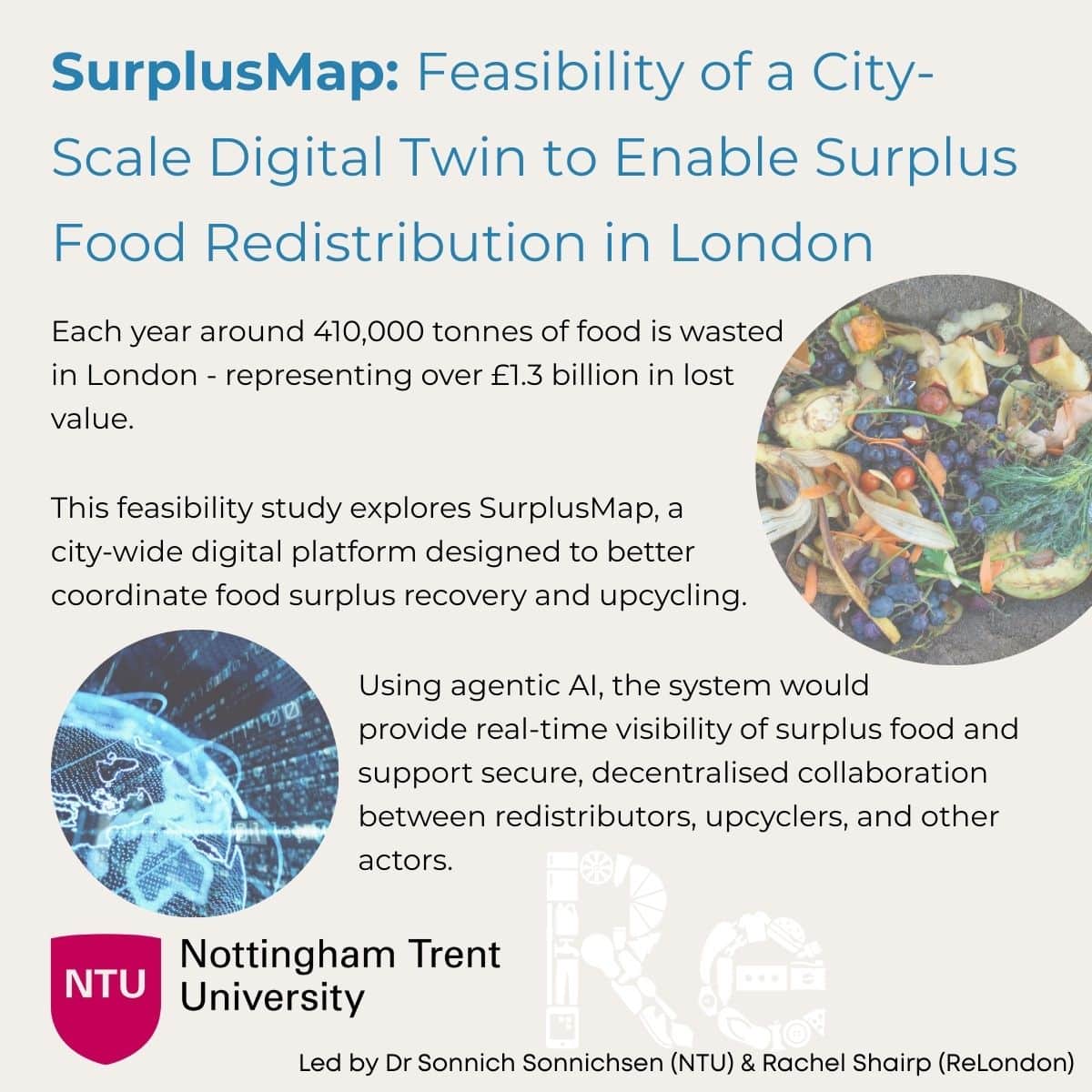
SurplusMap: Feasibility of a City-Scale Digital Twin to Enable Surplus Food Redistribution in London
Led by Dr Sonnich Sonnichsen from Nottingham Trent University, and Rachel Shairp of ReLondon.
The study will assess technical options, data governance, and participation incentives.
Its goal is to prepare for a scalable pilot that transforms food surplus into value, reduces system inefficiencies, and supports a more circular economy in London.
The Nottingham Trent University has partnered with ReLondon.

Busloads of Value: Circular, Digitally Enabled Business Models for Retrofitted Bus Fleets
Led by Dr Jay Lin and Dr Dimitrios Pappas from Queen’s University Belfast.
Two Core Contributions:
Minimal Viable Battery Passport
Operator-ready, proportionate, contract-linked:
- Only fields that change decisions
- Attribute → clause → governance rule
TL-BMC as Contract Design Tool
Two contractable archetypes:
- Resource Security (rights, take-back, verified routing)
- Circular Local Value (second-life storage, shared value)
Project Structure
WP1: Synthesis and passport co-design
WP2: Archetypes and viability conditions
WP3: Contract-ready blueprint and clause library

Robotic and AI-enabled sensing for timber reuse: testing the feasibility of AI-ready material passports to unlock circular construction automation
Led by Dr Vijay Pawar & Dr Colin Rose from UCL.
The team address a gap in open-access datasets to stimulate SME engagement and widen research collaboration.
In the future, combining Robotics, AI and circular design principles will create a digital infrastructure enabling new approaches to value generation that transform waste into trusted, low-carbon materials.
Demonstrator Projects
2 funded projects
Our Demonstrator Projects support the development and testing of digital innovations in practical settings, exploring how emerging technologies can enable scalable circular economy solutions and create opportunities for wider adoption.
AI-Powered Gamified Digital Product Passports: A Demonstrator for Enhancing Consumer Engagement in Circular Fashion and Textiles
University of Glasgow | Led by Abraham Zhang
This project develops a demonstrator of Digital Product Passports (DPPs) with AI-powered gamification features to enhance consumer engagement in circular fashion and textiles. Despite growing DPP policy momentum, consumer engagement remains a challenge. Building on prior research, we will co-develop and pilot a functional DPP system using real-world data with industry partners, integrating gamification features augmented by responsible AI. Through behavioural experiments, the project will establish the effects of AI-powered gamification features on consumer engagement with DPPs for sustainable behaviours. It will also quantify their commercial value and environmental impacts while providing insights into practical DPP implementation and scalability.
Buildings as Materials Banks to be ReUsed (BAMBRU)
Lancaster University | Led by Ana Rute Costa
The BAMBRU project will demonstrate how pre-demolition audits (PDAs) can generate high-quality data to create Digital Product Passports (DPPs) for existing materials, enabling scalable circular construction. Using Glass Partition Systems (GPSs) and Fire Doors (FDs) as high-value materials case studies, it shows how DPPs can inform material-led design and procurement and support the business case for reuse. This approach increases confidence in specifying reclaimed materials, reduces waste, carbon emissions, and costs, strengthens local circular supply chains, and will accelerate low-carbon, resource-efficient construction practices.

From Research to Real-World Impact
Funding innovative ideas is only the beginning.
As our projects progress, we’re bringing together researchers, industry partners and the wider DICE community to exchange knowledge, share emerging findings and explore opportunities for collaboration.
Through research publications, insights, webinars and knowledge-sharing activities, we’re helping make the learning from these projects accessible beyond individual research teams.
Explore our Resources & Insights