

Beyond the E-Waste Trap: Applying the Sustainability Hierarchy Framework to Digital Infrastructure
The unprecedented surge in AI and compute demand is accelerating a global race for digital capacity. While investments pour into expanding infrastructure, this rapid growth exposes a profound systemic bottleneck: our digital economy remains trapped in a linear “take-make-dispose” model. Rapid 3–5-year hardware refresh cycles discard functional components that could operate reliably for 8–10 years, driving the fastest-growing waste stream on the planet. With over 70% of critical raw materials (CRMs) concentrated in single geographic corridors and less than 1% of CRM demand currently met through e-waste recycling, linear digital expansion presents severe environmental liabilities and supply-chain vulnerabilities.
Solving this challenge requires moving beyond downstream remediation. Conventional approaches often lean exclusively on the traditional waste hierarchy, inadvertently framing digital sustainability as a recycling or e-waste management problem.
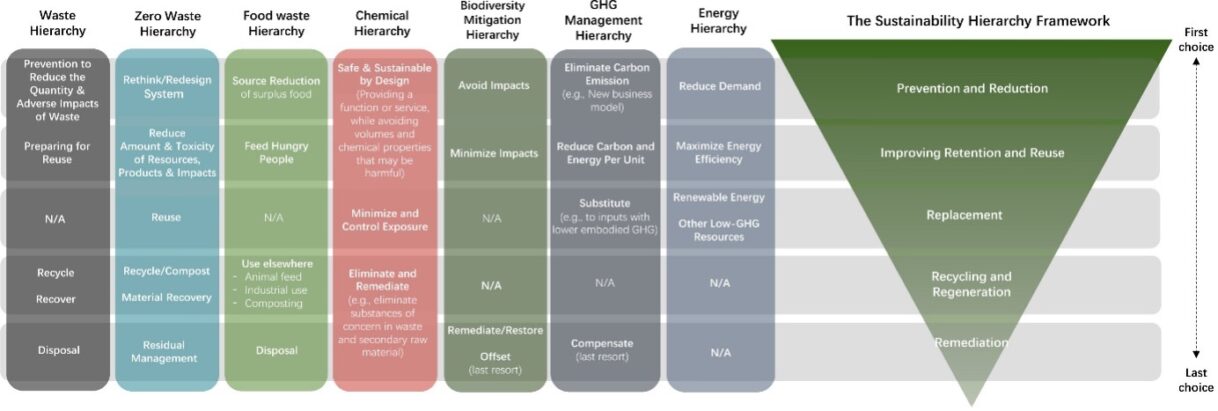
To break this silo, Dr. Melissa Wang from Greenpeace Research Labs along with several colleagues introduced the Sustainability Hierarchy Framework (SHF) published in iScience. The SHF provides a cross-domain compass that reorients governance, policy, and private investment upstream toward absolute resource reduction and value retention. By integrating the SHF with the DICE Network’s three strategic levers: Design for Value Retention, Operate for Maximum Value Recovery, and Collaborate for Systemic Change, we can systematically redesign digital infrastructure across data centres, advanced connectivity, and end-user hardware.
The Sustainability Hierarchy Framework (SHF)
The SHF establishes a five-tier hierarchy designed to evaluate and prioritise sustainability interventions across entire value chains:
- Prevent and Reduce Resource Extraction and Consumption: Prioritising absolute reductions in virgin material extraction and halting overconsumption at the source.
- Improve Retention and Reuse of Extracted Resources: Maximising the functional lifespan and embedded value of products through modular upgrades, direct reuse, and circular business models.
- Replace Problematic and Hazardous Resources: Substituting toxic substances and high-carbon inputs with safe, sustainable alternatives (Safe and Sustainable by Design).
- Recycle and Regenerate Resources: Recovering secondary raw materials through high-yield mechanical recycling and remanufacturing only after higher tiers are exhausted.
- Remediate Residues and Impacts: Neutralising remaining ecological damage, complementing rather than substituting for upstream action.
Crucially, the SHF excludes carbon and biodiversity offsets, recognising that compensatory schemes often delay necessary structural changes and fail to address root resource drivers.
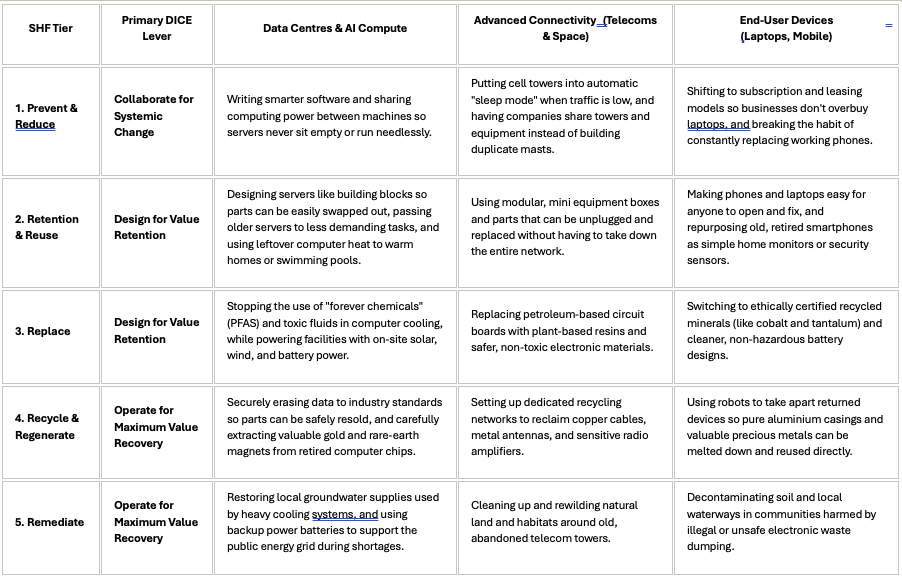
Applying the SHF Across the Digital Infrastructure Value Chain
Mapping the SHF alongside the DICE Network’s levers demonstrates how digital infrastructure, from data centres to end-user devices, can evolve from fragmented initiatives into a structured, high-impact portfolio:
Activating the Circular Flywheel
Translating this matrix into practice requires breaking the conventional “sustainability sandwich”, where long-term sustainability procurement criteria are forced out by economic short-termism, and building trust in circular products and business models.
When infrastructure is designed for longevity and disassembly (Lever 1), operators can scale secondary market resale, component cascading, and heat off taking (Lever 2). Over 90% of electricity entering a data centre is dissipated as low-grade thermal energy; innovative models like Heata and Deep Green redirect this heat to power municipal hot water networks and public swimming facilities.
These operational wins prove the commercial viability of circularity, providing regulators and industry coalitions the evidence needed to advance progressive frameworks (Lever 3); such as the EU’s Ecodesign for Sustainable Products Regulation (ESPR), Digital Product Passports (DPPs), and public “refurb-by-default” procurement targets.
Transitioning from a narrow focus on Total Cost of Ownership (TCO) to Total Value of Sustainability (TVS) enables organisations to track circular performance indicators: hardware lifespan extensions, secondary market revenues, and critical raw material recovery rates. Through the combined lens of the Sustainability Hierarchy Framework and DICE levers, digital infrastructure ceases to be an extractive resource sink and becomes a resilient foundation for the digital economy.