
Smarter End-of-Life Recovery: How "Circularity Triage" Maximises Product Value Retention
When complex products reach the end of their useful lives, determining whether to reuse, repair, remanufacture, or recycle them is rarely straightforward. Refurbishers and manufacturers face significant diagnostic uncertainty; they seldom know an item’s internal wear, remaining lifespan, or residual value without costly inspection.
A new article published in the Journal of Manufacturing Systems introduces a breakthrough approach to solve this challenge. Developed by Richard Fox, co-authored with Youxi Hu, Rui Li, and Yongjing Wang at the University of Birmingham’s School of Engineering under the EPSRC RoboTriage project and in association with the DICE Network+, the research formalises circularity triage as an adaptive, intelligent decision-making framework.
Moving Beyond Guesswork and Rigid Procedures
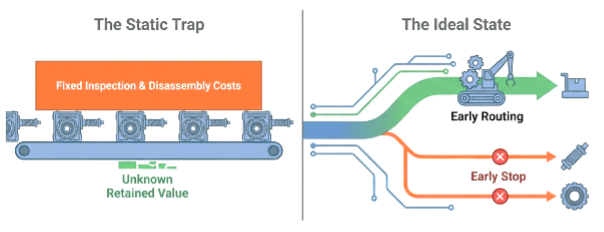
Traditional recovery systems often rely on fixed, one-size-fits-all inspection routines. This rigid approach frequently leads to two costly mistakes: scrapping products prematurely, or over-dismantling items past the point where recovery remains profitable.
Borrowing principles from medical triage, circularity triage treats product assessment as a step-by-step, evidence-driven process:
- Preliminary Triage (Rapid Screening): The Digital Twin based model compares incoming, worn products against their original “as-manufactured” digital specifications to quickly evaluate baseline health and reduce ambiguity through non-destructive evidence (e.g., visuals, radio frequency identification (RFID) records, digital product passport (DPP)).
A Value-of-Information (VoI) assessment determines structural relationships, part accessibility, and disassembly constraints to clearly map the different recovery pathway (e.g., reuse, repair, repurpose, remanufacturing, recycle) and ensure only viable, feasible, and safe dismantling steps are considered.
- Product-Level Triage (Functional Testing): If preliminary triage shows that component disassembly is unnecessary, the intact product undergoes sequential, non-destructive evaluations, like power-on and functional tests, to gather cost-effective condition data rather than fully uncovering its physical state. Each test progressively updates the product’s Digital Twin, condition confidence, and residual value, allowing the system to continuously determine whether current evidence is sufficient to recommend a recovery pathway or if further testing remains economically worthwhile.
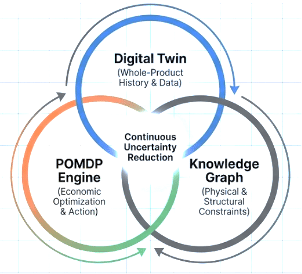
- Component-Level Triage (Selective disassembly): When disassembly is required, the system shifts from the whole product to individual recoverable components and actively weighs the marginal VoI of gathering more inspection data against the escalating costs of further disassembly through a physical rulebook: knowledge graphs (KG), which determine the optimal disassembly sequence where a component cannot be targeted until its precedent blockers are removed, and a partially observable Markov decision process (POMDP) engine, that calculates the “optimal stopping point” where further disassembly becomes uneconomical, based on thresholds like product type, market value, inspection costs and repair or remanufacturing costs, component demand, safety requirements, organisational risk tolerance, and historical recovery data.
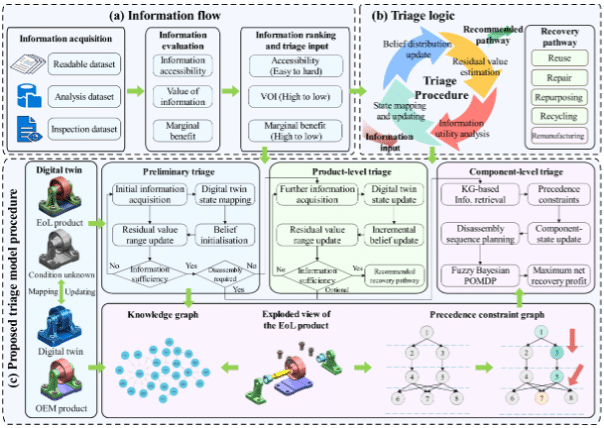
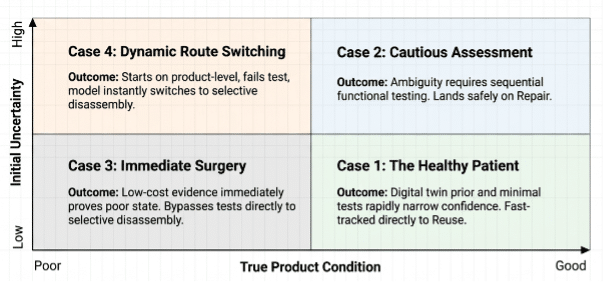
Unlike static models that treat recovery as a simple classification task, this adaptive approach treats every inspection or disassembly step as both a physical operation and an information-gathering action. The model was validated using a worm gearbox across four scenarios with varying conditions and uncertainty levels.
Preventing Excessive Intervention
The true strength of this model is its ability to know when to stop. If taking another component apart costs more than the value it unlocks, the process halts; locking in the maximum net recovery benefit.
By turning uncertainty into calculated, progressive decisions, circularity triage provides circular business models with an economically viable, data-driven pathway to keep valuable resources in high-value circulation.
Challenges, future directions, and next steps
Although information is acquired incrementally; from simple RFID scans to complex functional testing, the main hurdles include overcoming availability, traceability, and sharing of fragmented multi-stakeholder data, through DPPs for example, and maintaining scalability for complex assemblies via hierarchical subsystem screening.
Product structure and design data are held by manufacturers, use and maintenance records may be held by users or service providers, and inspection and disassembly data are generated by recyclers or remanufacturers.
The authors identify two primary paths for future development:
- Constructing a generalised EoL knowledge base: Future work will integrate various EoL products, component structures, degradation patterns, and recovery rules to build a more comprehensive and transferable recovery knowledge base. This will improve the scalability, traceability, and cross-product applicability of the proposed triage model.
- Integrating automated inspection technologies: Advanced robotic vision, sensing, and intelligent detection methods will be incorporated into the triage process to automate condition assessment. These technologies can further reduce the marginal cost of information acquisition and improve the speed and cost-effectiveness of uncertainty reduction.
The proposed circularity triage model transforms EoL recovery from a static, experience-based procedure into an adaptive, explainable, and benefit-oriented sequential decision process. By explicitly weighing the cost of information against the potential recovery value, the model prevents the economic loss associated with over-disassembly and ensures that recovery pathways are optimised for the specific condition of every returned unit. This model has the potential to support more scalable, intelligent, and economically sustainable circular economy practices.