

Accelerating Circular Data Centre Infrastructure: Insights from the DICE Network+ Deep Dive
Throughout late 2025 and early 2026, the DICE Network+ convened experts from data centres, policy, academia and investment firms to explore one of the most pressing challenges in the UK’s digital economy: how to transition the data centre sector to a circular economy framework.
Across a three‑stage deep dive, comprising an in‑person roundtable in November 25, a strategy sprint in February 26, and a high‑profile panel discussion at Data Centre World in March 26, we brought together over 30 specialists from the sector. Their shared insights have now been synthesised into a policy brief submitted to the Data Centre APPG.
Why Now? The Growing Pressure on Digital Infrastructure
Across the UK, competition for AI compute is accelerating rapidly. Investments like Microsoft’s recent $30 billion commitment to UK data infrastructure are contributing to a projected 20% market growth over the next five years. This unprecedented expansion creates significant pressure on materials, energy demand, and supply chains.
Yet current business models are not designed for circularity. Annual Capex cycles prioritise uptime and service efficiency, leaving little room for long‑term thinking around reuse, life extension, or recovery of high‑value components. This misalignment sits at the heart of the challenge.
Our discussions set out to examine how new approaches, business models, and policy mechanisms could unlock value and resilience across the sector. The outputs of our deepdive provide important evidence-based insights to the sector, with more engagement planned throughout 2026.

DICE N+ Policy Brief: Transitioning to a Circular Economy Framework

DICE N+ Data Centre Deepdive Integrated Results

DICE N+ Data Centre World Panel 2026

Roundtable: Identifying Barriers and Opportunities
In November, we met with 25 experts at Sustainable Ventures in London, representing data centre operators, major industry players, investors, policy specialists, academics and circular economy organisations.
Key insights included:
- Rapid AI and compute growth is intensifying resource pressures, not only in memory chips and GPUs but across multiple hardware categories.
- Short-term Capex-focused models disincentivise recovery and reuse, even when remanufactured equipment could provide value and reduce risk.
- Lack of transparency and traceability across component lifecycles makes it difficult to confidently redeploy or resell IT infrastructure.
- Regulation is evolving quickly, especially around Digital Product Passports (DPPs), but industry alignment is fragmented.
This session set the foundations for our next phase: exploring solutions.
Strategy Sprint: Designing an Open-Source Secondary Market Platform
Building on the roundtable, in February 2026 we convened 15 participants for a half‑day online Strategy Sprint focused on recovery, reuse, and circular business models.
The session centred on co-developing a roadmap for an Open-Source Digital Secondary Market Platform, drawing inspiration from:
Participants explored how such a platform could:
- Integrate Digital Product Passports to track provenance, condition, and component histories
- Support Hardware‑as‑a‑Service (HaaS) and distributed compute models
- Enable UK‑based recovery, resale, and recommissioning
- Align with ESPR regulation and emerging policy expectations
The outcome was a shared vision for a scalable, transparent, UK‑focused digital marketplace enabling high‑value reuse across the data centre ecosystem.

Data Centre World 2026 Panel
Building on the two sessions, the DICE Network+ convened an expert panel at Data Centre World in London on 4 March 2026 entitled: ‘Scaling Circularity: How to create a Resilient, High-Value Data Centre Infrastructure’.
Together, the panel examined the material, operational, and systemic pressures facing digital infrastructure as AI‑driven demand accelerates and the presented opportunities for circular solutions to unlock new value, reduce risk, and extend the useful life of critical equipment.

Several themes stood out:
- Demand now exceeds supply across multiple technology categories which is a clear warning of the resource pressures ahead.
- Circularity must be designed in, not retrofitted. Remanufacturing has a role, but design-for-reuse is essential.
- Organisations remain hesitant about remanufactured IT in operational environments, despite widespread acceptance with used tech in homes.
- Sustainability cannot be an afterthought. Opportunities include life extension, modular upgrades, reverse logistics, and heat reuse, all of which can contribute to resilience as well as carbon reduction.
Diego Bermudez, our Research & Impact Fellow, continued this conversation into Day 2 where he spoke on the panel ‘Beyond Waste: Designing for Disassembly and Reuse’.
These conversations reinforced the need for coordinated action across policy, industry, and research.
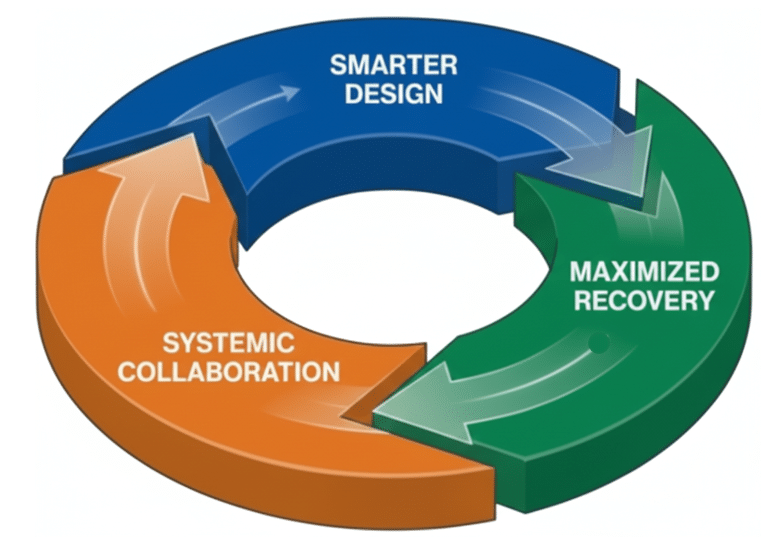
Shaping Policy: Submission to the Data Centre APPG
All findings from the Deep Dive series have now been synthesised into a policy brief submitted to the Data Centre All-Party Parliamentary Group (APPG).
The briefing highlights:
- The urgent need to align financial incentives with circular outcomes
- Opportunities for regulation to better support reuse and recovery
- The potential for UK leadership in secondary markets and transparent supply chains
- The importance of standards, data-sharing, and digital tools like DPPs
This marks an important step in influencing national discussion on the future of data centre infrastructure.
Read more >
What’s Next?
The Deep Dive series is just the beginning. Over the coming months, the DICE Network+ will continue to:
- Engage with policymakers, regulators, and industry leaders
- Support innovation through our Flexible Fund and Demonstrator work
- Build momentum toward a circular, resilient digital infrastructure for the UK
If you’re interested in contributing to this ongoing work, please get in touch.