

Reflections from the REACT Urban Mining Workshop
Event: REACT Urban Mining Workshop
Date: 05/03/2025
Venue: Royal Academy of Edinburgh
The DICE Network+ was pleased to join industry leaders, researchers, and policymakers for a stimulating day of discussion at the Urban Mining Workshop organised by REACT. The event highlighted the critical role that secondary raw materials will play in the UK’s transition to a resilient, circular, and sovereign materials system.
Urban mining is far more than a waste‑management challenge. It represents an essential pathway for securing the UK’s access to critical materials in an increasingly volatile global landscape. Throughout the day, speakers emphasised both the scale of the challenge and the opportunities emerging across policy, research, and industry.
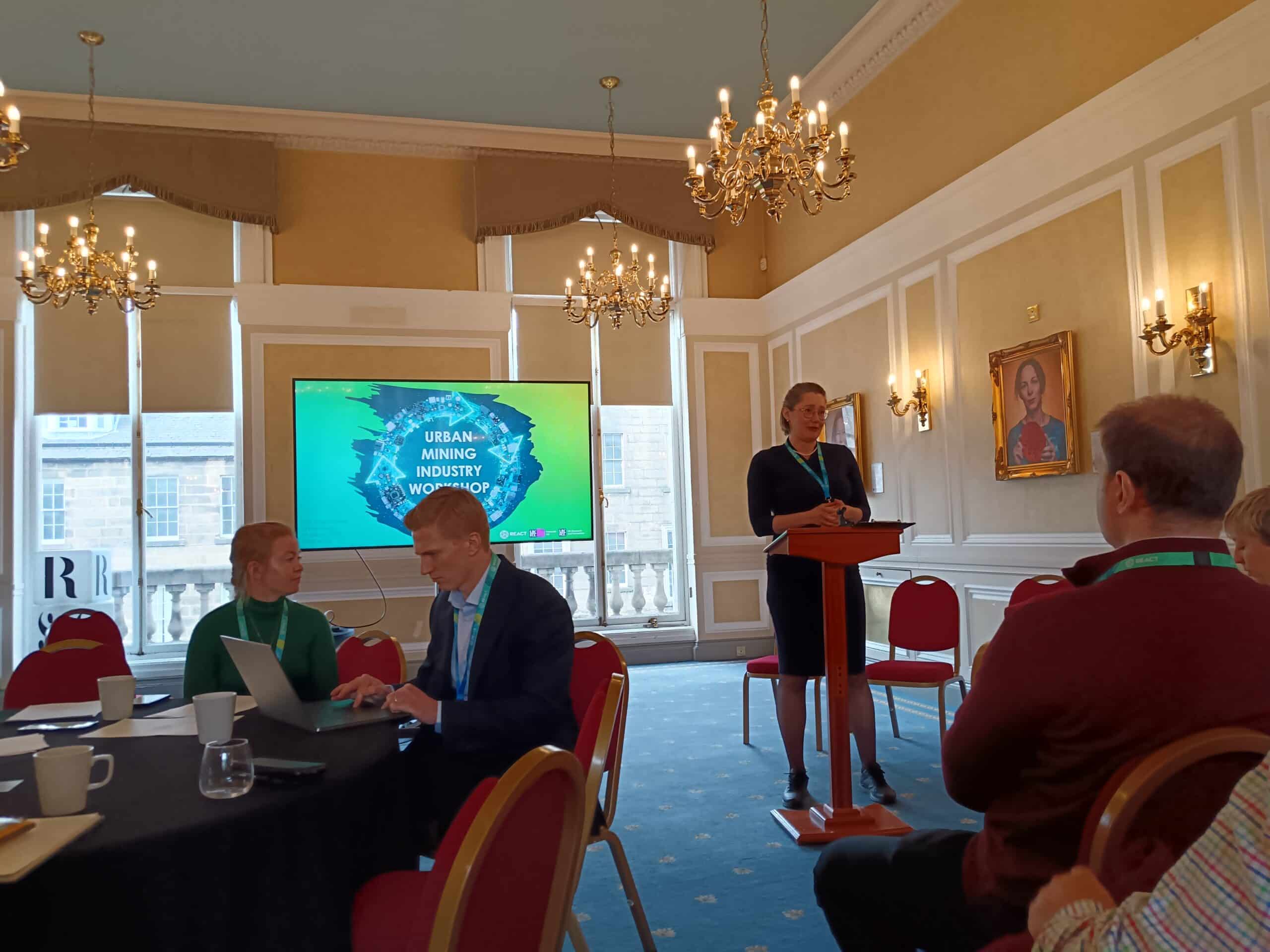
Opening Remarks
The workshop opened with Jeff Kettle (REACT PI) and Natalia Lukaszewicz, who framed the conversation within the broader national shift toward circularity. Their welcome coincided with the publication of Scotland’s Circular Economy Strategy (March 2026), underscoring a growing momentum across the UK. Both speakers called for a “network of networks” approach to sustainability, positioning collaboration as the foundation for progress.
Keynote: Resource Security in a Global Context
Professor Paul Monks delivered an insightful keynote on the geopolitical and economic landscape shaping the UK’s resource security.
Global Dependencies
Many critical materials remain heavily concentrated in regions including China, the Democratic Republic of Congo, and South America. These dependencies present significant supply‑chain risks for the UK and highlight the need to diversify sources and strengthen domestic capability.
Industrial Strategy 2035
The UK’s new Industrial Strategy sets an ambitious objective: Twenty percent of critical metals must be supplied through recycling by 2035.
Meeting this target will require long‑term investment, innovation, and coordinated effort across sectors.
Role of Intelligence
Paul highlighted the work of the Critical Minerals Intelligence Centre (CMIC), whose interactive resources provide essential visibility of national strengths, gaps, and opportunities in critical mineral supply and processing.
Complexity of Refining
He also emphasised the technical challenges associated with mineral refining, particularly where companion minerals are involved. Despite rapid advances in renewable technologies, diverse and transitional technologies will be required as part of the strategic mix.
Economic Realities
One stark figure stood out: materials recovered through urban mining can currently cost almost 10,000 times more than those obtained from traditional ore. Closing this gap will require scaled innovation, supportive policy, and significant investment.

Industry Perspectives
Matthew Reeves (Innovate UK) shared insights from the CLIMATES programme, which has funded 36 projects with £18 million to strengthen UK rare‑earth supply chains. Presentations from organisations including Hypromag, Bioscope, and Descycle demonstrated that many of the technical solutions for material recovery already exist. The challenge now lies in accelerating deployment and commercialisation.
Panel Discussion: From Innovation to Implementation
The final panel brought together experts from across the ecosystem:
- Andrew Gomarsall, MBE (n2s)
- James Horne (WEEE Forum)
- Scott Butler (Material Focus)
- Fred White (Descycle)
- Eva Marquis (Critical Minerals Challenge Centre, University of Exeter)
Key Themes
Culture and Procurement
A shift in procurement behaviour is needed to recognise the value of secondary materials. Without cultural change, market demand will remain limited.
Scaling and Finance
Many promising UK technologies fail to scale due to funding constraints and lengthy permitting processes. Faster, more accessible investment pathways are essential.
Data‑Driven Capability
Platforms such as FutuRaM (Urban Mine Platform) will play an important role in projecting future material flows and informing national CRM strategies.

Looking Ahead
As the UK moves toward the goals set out in the Industrial Strategy 2035, one message from the workshop resonated throughout: progress will depend on bringing together researchers, industry innovators, policymakers, and investors. The technology exists, but coordinated action and strategic investment will be essential to translate potential into impact.
The DICE Network+ looks forward to continuing to support this collaborative effort and helping to build a resilient, circular materials landscape for the digital future.