
Electronics & Circularity Roadshow: Connecting Materials, Value Retention and Circular Innovation in Belfast
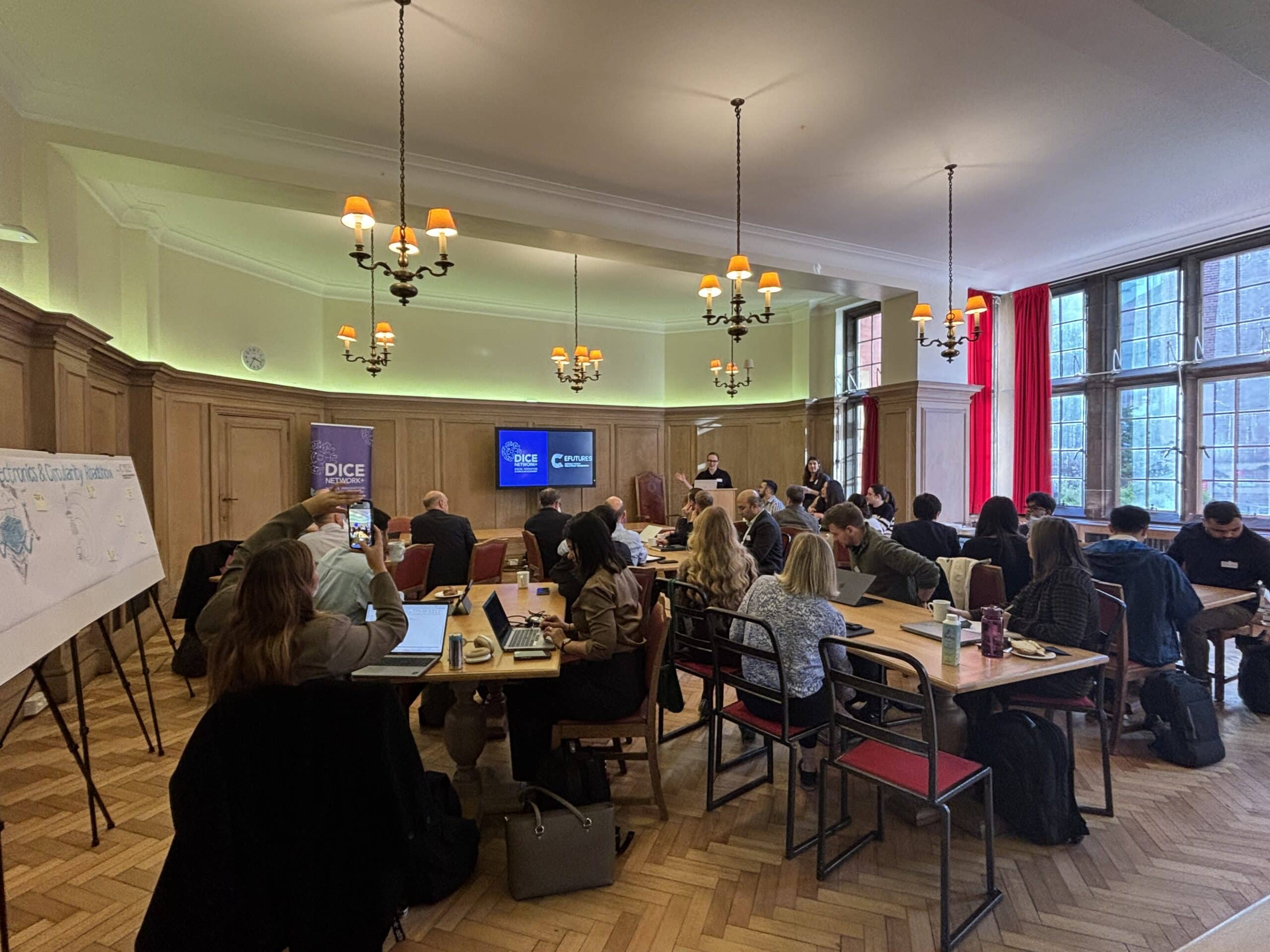
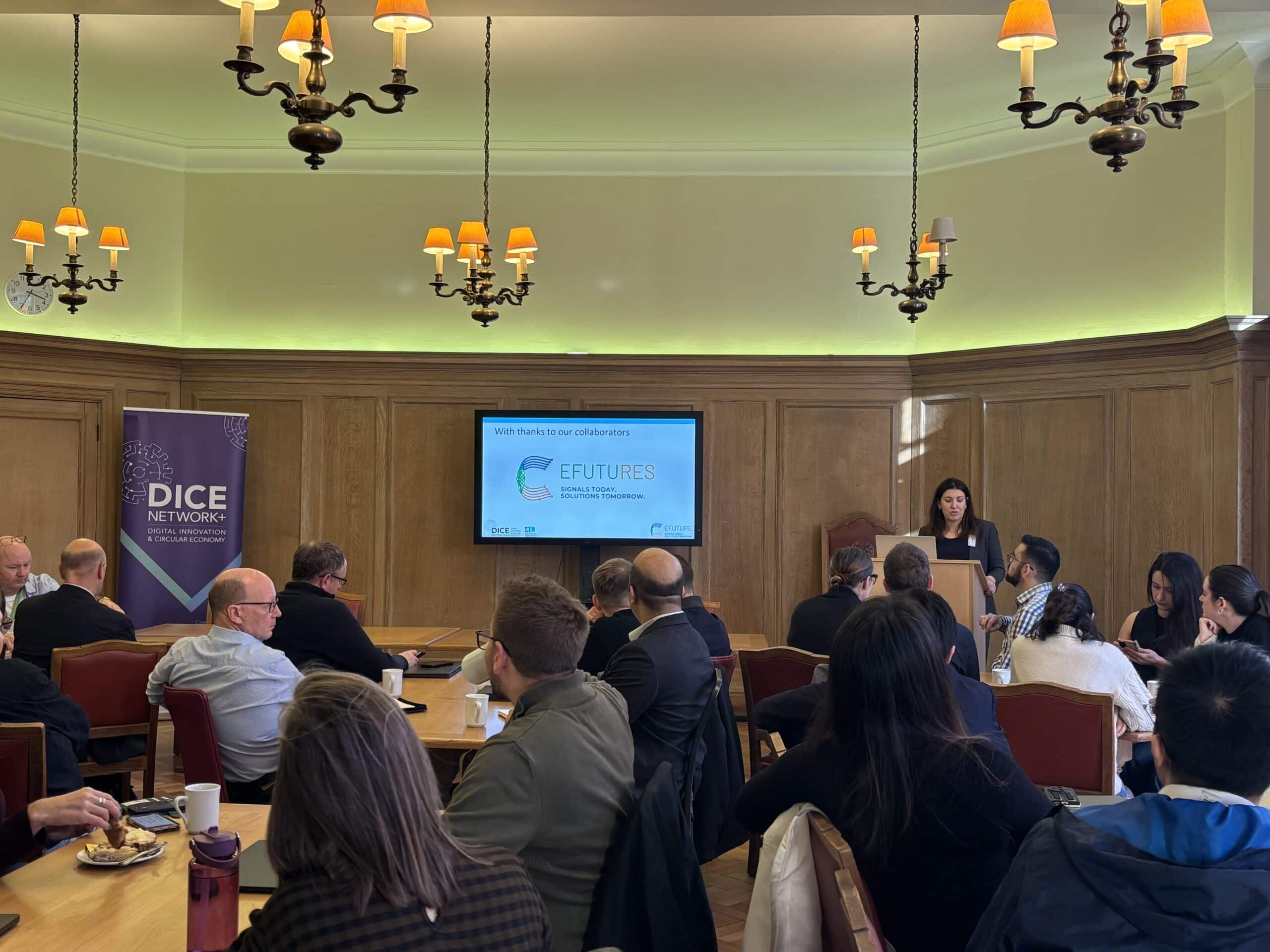
On 13 October 2026, DICE Network+ joined forces with the eFutures Network+ at Queen’s University Belfast for our Electronics & Circularity Roadshow, bringing together researchers, industry specialists and innovators to explore the challenges and opportunities shaping a more circular electronics ecosystem.
The day moved across the electronics lifecycle, from resource security and sustainable materials, through to value retention, life extension and standardisation, before bringing participants together in a solutions-focused workshop to explore practical routes forward.


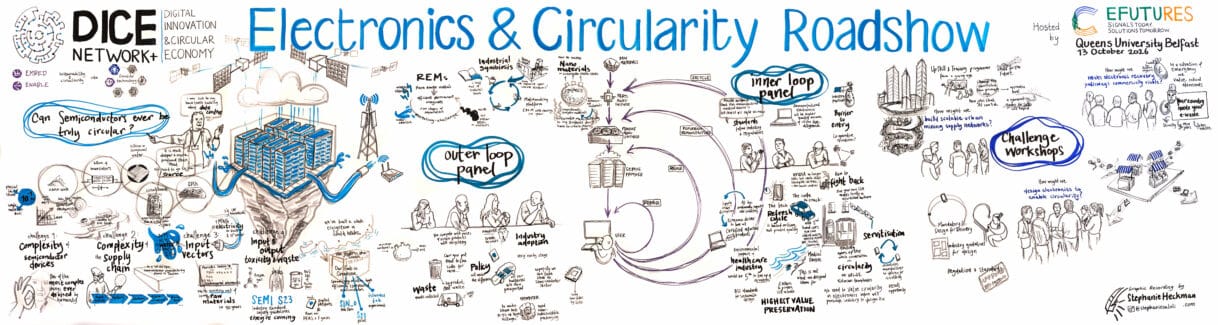
Can Semiconductor Manufacturing Ever Be Truly Circular?
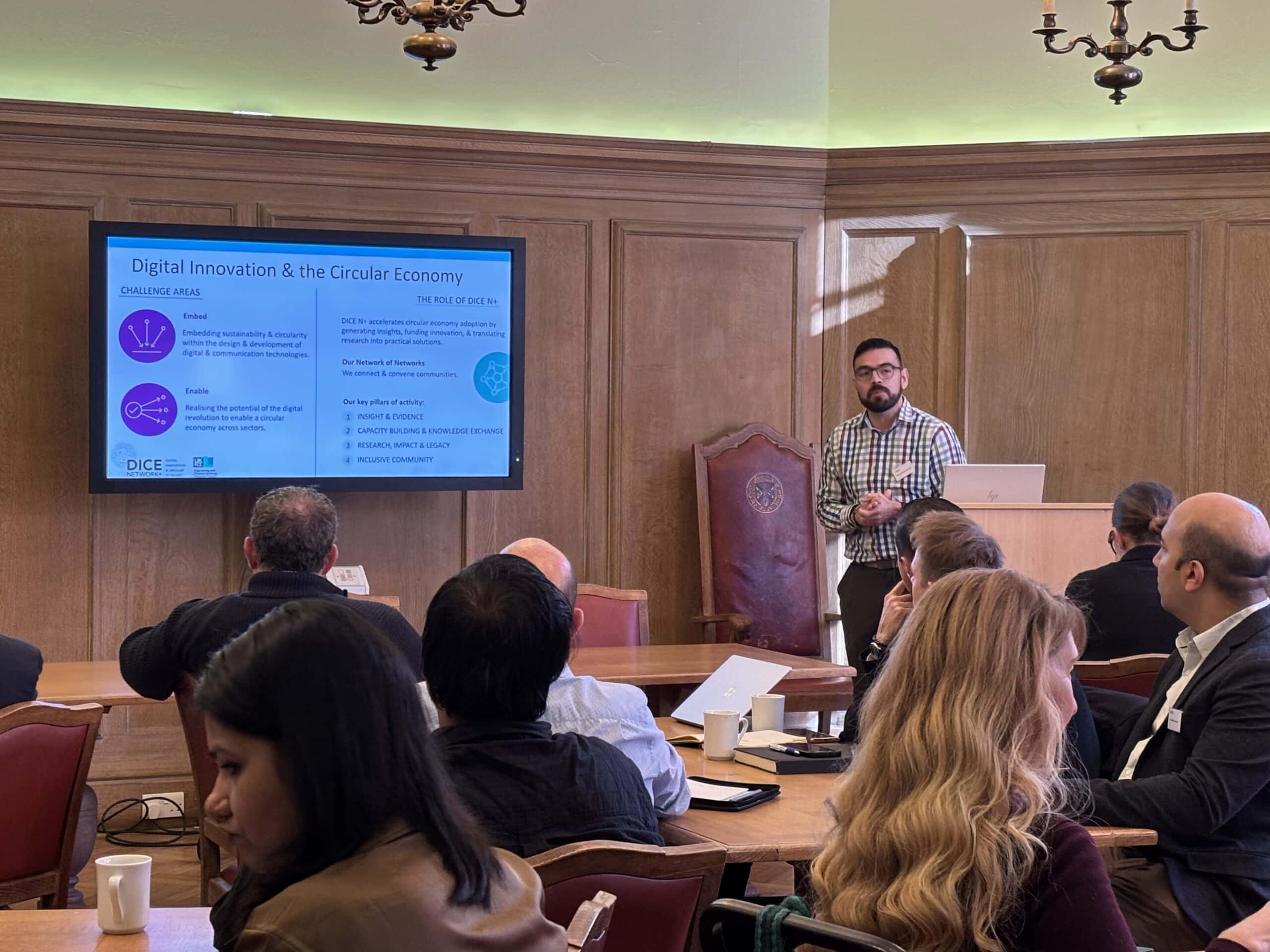
The day opened with Professor Paul Meredith, DICE Network+ Co-Lead, setting out the current landscape of semiconductor manufacturing and why the sector matters strategically.
Paul explored the scale and environmental footprint of semiconductor manufacturing, including the complexity of semiconductor devices and the significant requirements for energy, water and raw materials.
The session also considered opportunities for more sustainable manufacturing, including improving process efficiency, substituting critical materials, extending product lifecycles and designing for recycling.
This set the scene for the rest of the Roadshow, highlighting why greater circularity in electronics needs to begin not only at end of life, but at the point of design and manufacture.
The Outer Loops: Resource Security and the Feasibility Gap
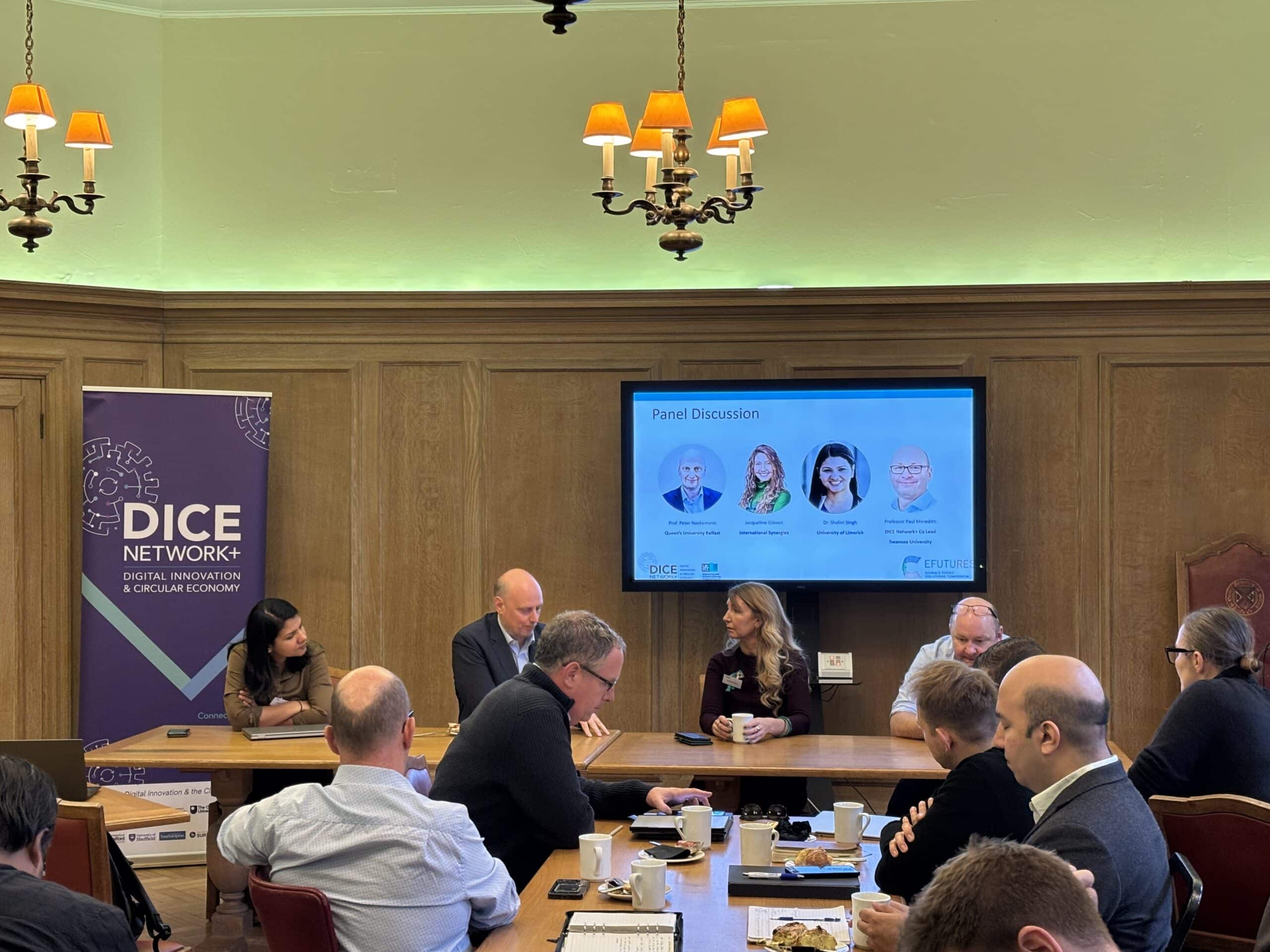
The first panel, chaired by Professor Gosia Swadźba-Kwaśny, focused on the Outer Loops, looking across materials, manufacturing, end-of-life, repurpose and recycling strategies.
A key theme was the “feasibility gap” – where technical complexity or limited economic value can make circular approaches difficult to implement in practice.
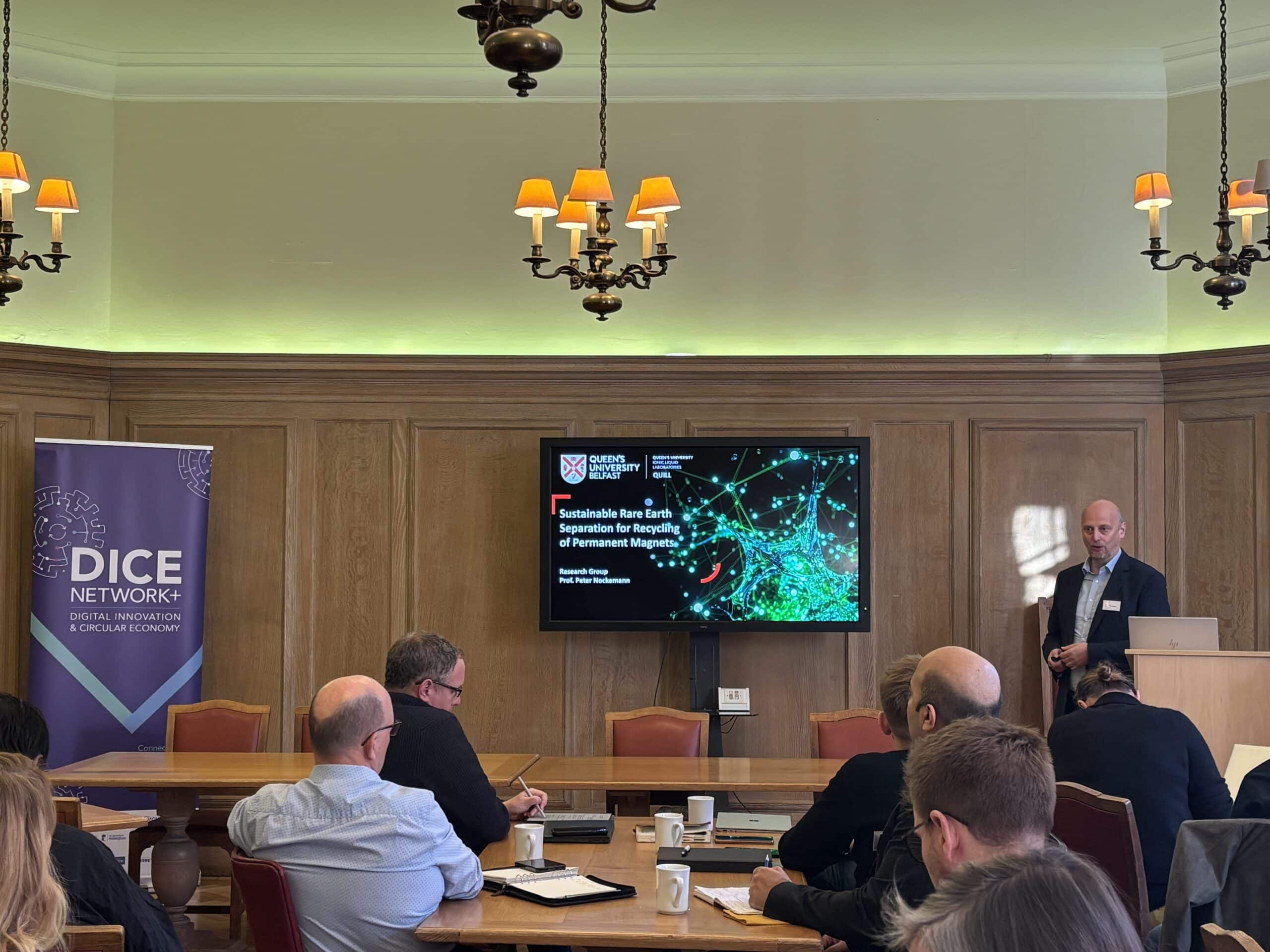
Professor Peter Nockemann presented Closing the Rare Earth Loop: Circular Hydrometallurgy from Lab to Plant, exploring the challenge of securing rare earth metals that are essential for green technologies and electronics. He shared Queen’s University Belfast research developing more selective approaches to rare earth separation and recycling, including patented technology that has progressed from laboratory research towards commercial application through a rare earth recycling plant in Belfast. Peter also introduced the iRECYCLE-Malaysia project, exploring how more sustainable recycling processes could help address e-waste challenges and improve critical metal recovery in Malaysia.
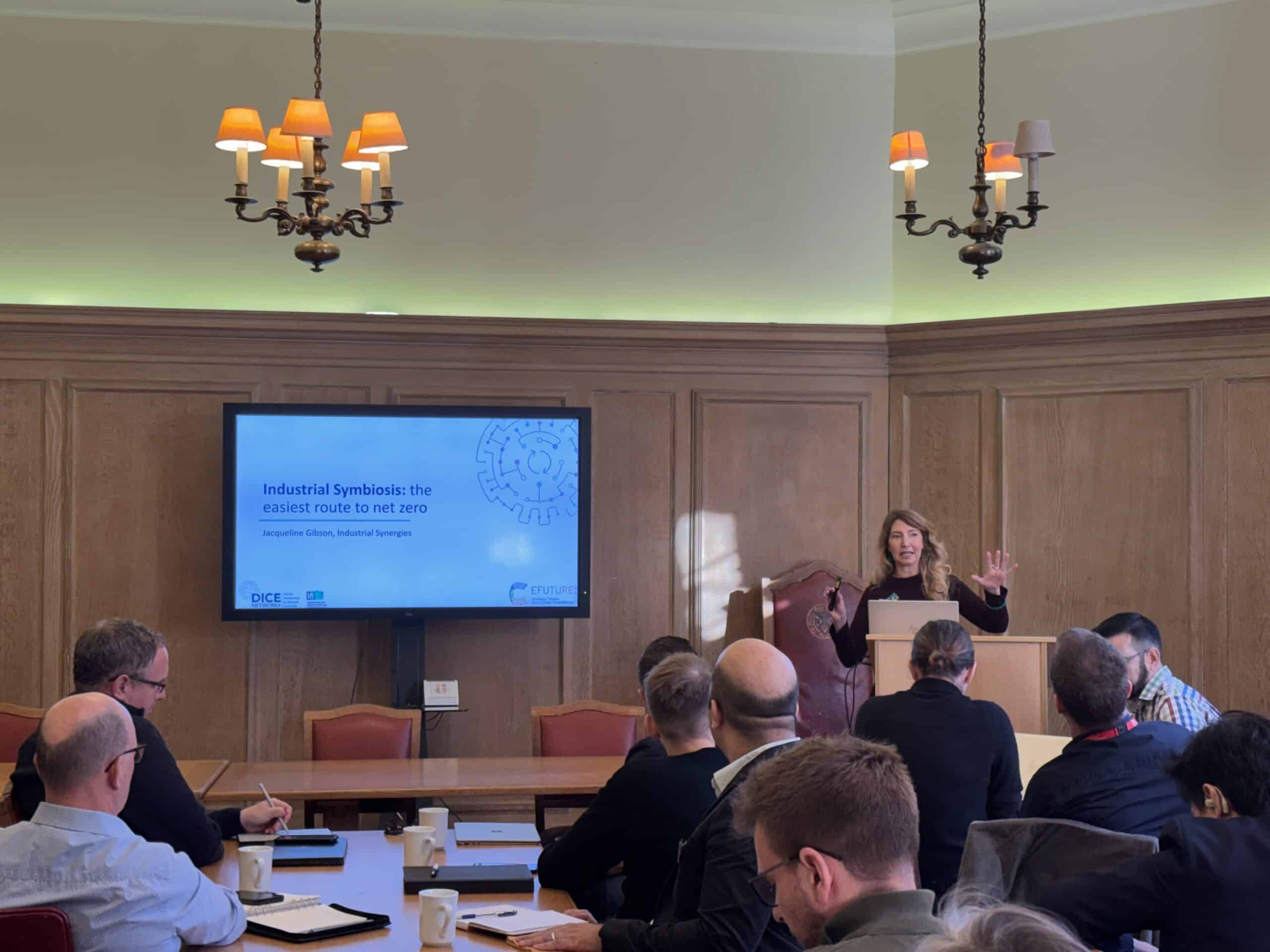
Jacqueline Gibson explored industrial symbiosis, where unused or residual resources from one company can be used by another. Her presentation highlighted how this approach can reduce operating costs and environmental impact while increasing business opportunities and cross-sector collaboration. She also shared examples from SYNERGie 4.0, a resource-matching platform supporting organisations to identify opportunities for resource exchange.
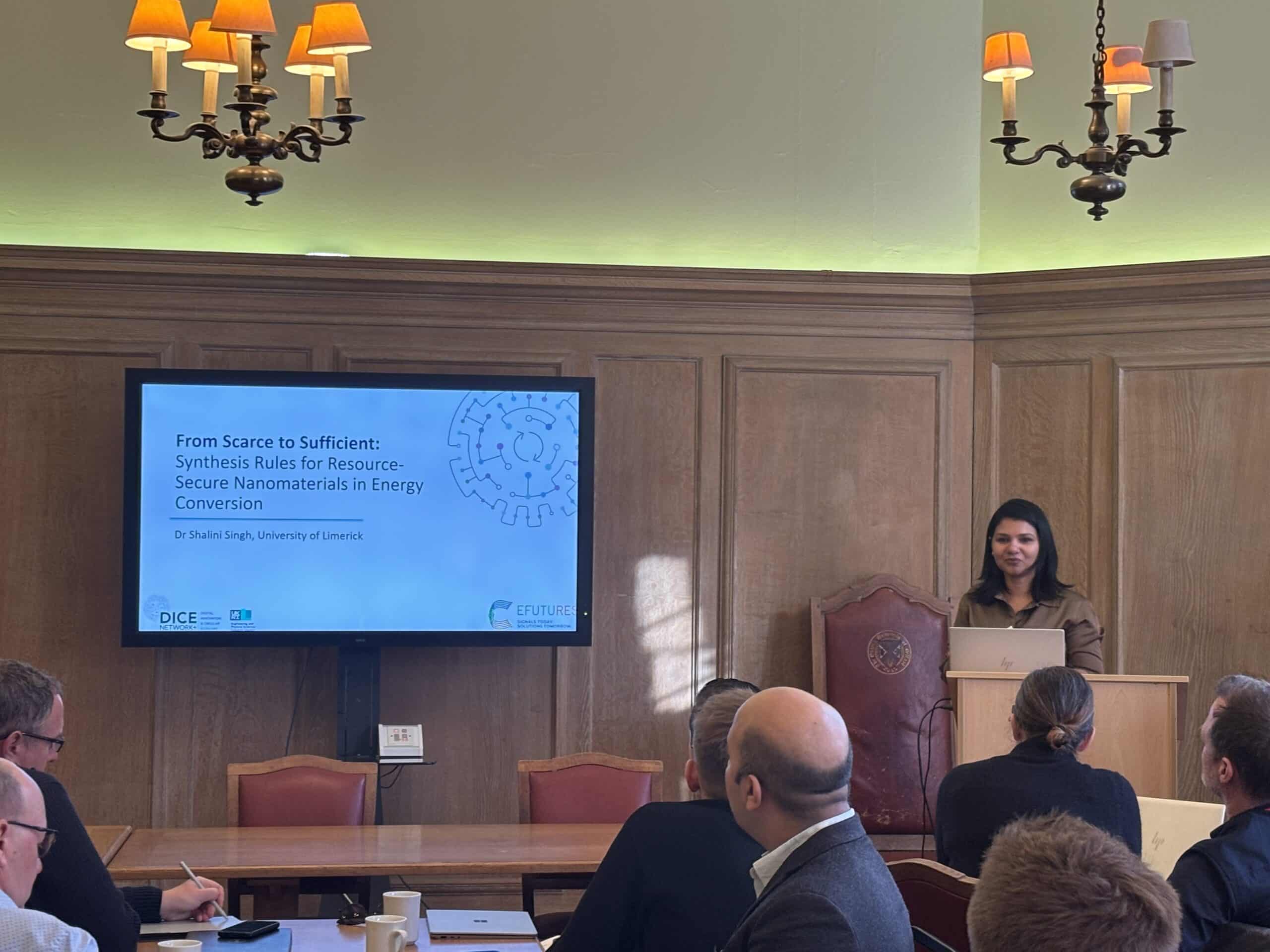
Dr Shalini Singh’s presentation, “From Scarce to Sufficient: Synthesis Rules for Resource-Secure Nanomaterials in Energy Conversion,” explored synthetic accessibility, the use of compositionally complex materials to replace scarce elements with more earth-abundant alternatives, and the potential of low-dimensional materials and circular synthetic processes to improve resource efficiency.
Together, the session highlighted how overcoming the feasibility gap requires thinking across materials, manufacturing, resource recovery and the systems that enable resources to circulate between organisations and sectors.

The Inner Loops: Value Retention, Life Extension & Standardisation
The focus then moved further up the circular economy hierarchy to consider how products, components and assets can be kept at their highest utility and value for longer.
Chaired by Diego Bermudez, DICE Network+ Research and Impact Fellow, the fireside chat brought together Alastair Winner, Head of Innovation and Services at TechBuyer; Cormac O’Prey, Director at Kestrel Technology Consulting and BSI Committee Chair; and Josh Watts, Senior Venture Associate at Sustainable Ventures.
The conversation explored upstream strategies including Refuse, Rethink and Reduce, alongside life-extension approaches such as Reuse, Repair, Refurbish and Remanufacture.
Main takeaways:
- Focus on Value Retention Over Simple Recycling: The panel centred on moving up the circular hierarchy (Refuse, Rethink, Reduce, Reuse, Repair, Refurbish, Remanufacture) because keeping physical hardware intact yields the highest economic, material, and carbon returns compared to downcycling or material recovery.
- Framing Second-Life Hardware as Supply Chain Resilience: Second-life enterprise IT is increasingly treated not merely as a cost-cutting or sustainability choice, but as a strategic solution to component scarcity, long lead times, and AI-driven supply crunches, reinforced by enterprise service-level agreements and support wrappers.
- Standardisation and Process Verification to Unlock Procurement: Mainstream corporate procurement hesitates around secondary hardware due to perceived warranty and compliance risks. A critical takeaway is the need to transition toward process standards (such as BS8887/ISO8887) and formal verification frameworks (like Digital Product Passports) that evaluate secondary assets based on process integrity rather than rigid per-product rules.
- Preserving Telemetry to De-Risk Residual Asset Value: Hardware health data collected continuously by enterprise server management controllers is often lost during ownership transfers. Retaining component telemetry across handovers is essential for proving asset health, underwriting warranties, and securing competitive leasing or financing terms.
- Bridging Grassroots Repair with Corporate Scale: Circular solutions require more than centralised enterprise processing plants; sustainable scaling depends on building operational bridges and funding channels between bottom-up, community-led reuse/repair ecosystems and institutional supply chains.
Together, the discussion highlighted that value retention is not simply a technical challenge. It also depends on data, standards, procurement, commercial models and the wider systems that make reuse and life extension viable at scale.
From Challenges to Solutions
In the afternoon, ReJig led participants through a solutions-focused design thinking workshop, using “How Might We?” challenges to turn some of the issues raised throughout the day into potential solutions and business models.
How might we design electronics to enable circularity?
Participants explored ideas around disassembly and modular hardware, material simplification, alternative substrates and new business models.
The group slected the concept of Increased Awareness (Mandatory Design for Recovery) – shifting from reactive end-of-life recycling towards proactive upstream design for circularity.
The proposed pathway included research into design, manufacturing and reprocessing, followed by industry guidance, engineering standards, regulatory drivers and certification to support wider adoption.
How might we make electronic recovery pathways commercially viable?
The second group explored ways to improve the economics of electronics recovery through incentives, better valuation of materials, digital information and market intervention.
Ideas included deposit-return models, stronger links between product information and commodity values, and changing the way e-waste is perceived – from something to dispose of to a source of strategically important materials.
The group selected the concept “Your Country Needs Your E-Waste!”, reframing electronics recovery around critical material security and national resilience.
How might we build scalable urban mining supply networks?
The third group considered the policy, infrastructure, workforce and community participation needed to scale urban mining.
Ideas included stronger collection systems, policy and finance mechanisms, community repair activity and formal skills pathways for materials recovery.
The group developed a 21st-Century “Rag & Bone” Skills & Training Programme, proposing education and vocational routes to build practical skills in electronics harvesting, repair and recovery while strengthening the domestic recovery workforce.

What Comes Next?
The Belfast Roadshow brought together a wide range of perspectives on what it will take to move electronics towards a more circular future.
A clear message from the day was that there is no single intervention that will deliver electronics circularity. Progress depends on connecting activities across the whole system — from designing technologies and materials differently, to retaining value for longer, recovering critical resources and creating the policy, standards and partnerships needed to make circular solutions viable at scale.
Click here to view the event slides
Interested in how circular approaches can be scaled within the semiconductor industry?
Read Startups for Sustainable Semiconductors: A Model for Ecosystem-Collaborative Industrial Decarbonisation, exploring how the Startups for Sustainable Semiconductors (S3) programme is helping to overcome barriers to sustainable innovation in the resource-intensive semiconductor sector.
Read more >
Continue the conversation at REACT 2026
The conversation around circular electronics and digital infrastructure continues at the REACT 2026 Conference in Glasgow on 17-18 November.
DICE Network+ will be attending and sharing more from our work across digital innovation and the circular economy.
Register now >